
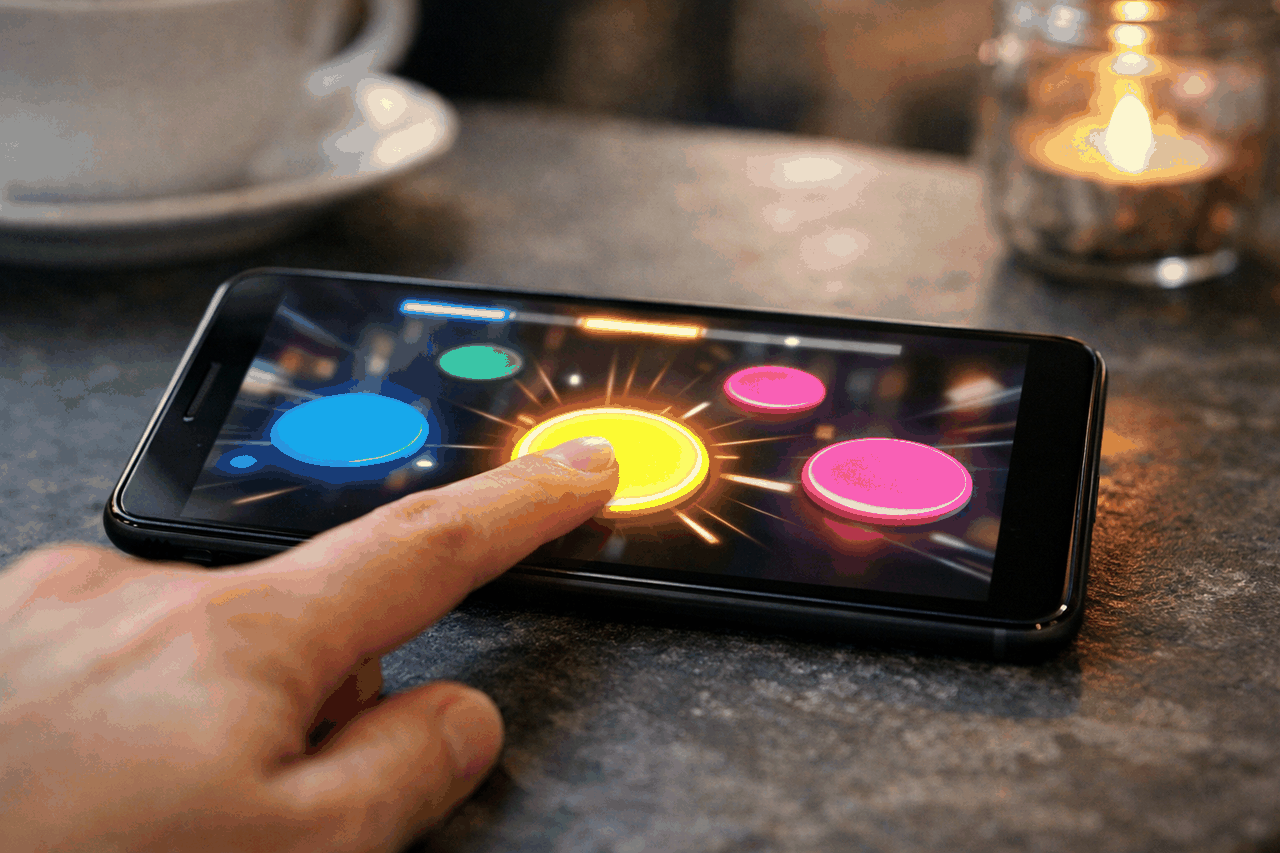
Choose the original DEEMO for piano-led tapping, a fairytale story, and documented offline solo play. Choose Arcaea for layered touch patterns, a free starting library, and optional online multiplayer. Choose Cytus II for a moving timing line, varied musical genres, and a character-driven story. Its complete offline behavior remains unconfirmed by the cited descriptions, especially for purchased content.
All three have iOS and Android listings. The most useful distinction is what your fingers follow: notes arriving at a fixed line, patterns spread across two levels, or a line moving through notes.
What your fingers actually do
Plan around direct touchscreen input. External gamepad and keyboard compatibility is unconfirmed in the listings cited here.
DEEMO: meet the notes at the bottom
Notes descend toward a fixed judgment line near the bottom of the screen. Tap as they arrive, and slide through connected patterns when required. That consistent destination gives your eyes a clear place to judge timing while your hands move across the screen.
The piano-centered presentation fits players who want their taps to feel connected to a musical phrase. Story progression unlocks more tracks, while exploration adds reasons to return between songs. This comparison covers the original DEEMO.
Arcaea: coordinate the floor and sky
Arcaea sends notes toward you along a track. Tap floor notes at the lower judgment line, handle sky notes above it, and keep a finger following curved arcs as they move. Hold notes require sustained contact. Patterns can combine these actions, so recognizing where to touch becomes part of the challenge alongside timing.
Choose it if learning a layered system sounds appealing. Start on a low difficulty and give yourself time to follow arcs accurately before adding denser combinations. Its high difficulty ceiling provides room to keep developing that coordination.
Cytus II: let the line tell you when
Notes appear around the playfield, and an active judgment line moves through them. Tap when the line crosses a note. Holds require continued contact, and drags ask you to trace a sequence. The publisher describes five note types and a line whose speed changes with the music.
Your eyes must track both the next target and the line’s approach. That makes Cytus II a strong fit if you enjoy reading patterns across the screen. Its character-based song selection spans styles including electronic, rock, and classical, with the iM story system connecting the cast.
Platforms and purchase structure
The listings establish availability on both mobile platforms. Their purchase labels help you choose an entry point, though prices, content bundles, and device requirements can change.
| Game | iOS listing | Android listing |
|---|---|---|
| Original DEEMO | iPhone and iPad. Paid download with in-app purchases. | Google Play listing with ads and in-app purchases. |
| Arcaea | iPhone and iPad. Free download with in-app purchases. | Google Play listing with in-app purchases. Publisher copy describes included free songs. |
| Cytus II | iPhone and iPad. Paid download with in-app purchases. | Paid Google Play listing with in-app purchases. |
Check the live store page for your device’s compatibility and required OS version before installing. A minimum requirement belongs to a particular release and can change with updates.
Solo play and offline access
DEEMO has explicit offline support. Its publisher descriptions on both stores call it a standalone game that can be played without an internet connection. Google Play also identifies it as single-player. That makes it a sensible choice when solo play away from a connection is a priority.
Arcaea supports offline base play and online multiplayer. Both store descriptions say an internet connection is unnecessary for play and describe a library of free songs included on installation. Friends, scoreboards, and real-time multiplayer are online features. An offline session and a multiplayer session therefore have different connection needs.
Cytus II needs a more qualified travel decision. Google Play labels it single-player and offline. Its iOS description also says in-app purchases undergo periodic connection authentication and directs players to connect and use Restore Purchases if purchased content becomes unavailable during that process. Complete offline access, including the behavior of purchased content on each platform, remains unconfirmed here.
Keep three questions separate: is an item unlocked, are its files downloaded, and can it be used offline? Account sign-in and any available sync function are separate operations too. An offline gameplay statement does not establish that purchases, downloads, or account transfers work without a connection.
A starting point for new players
| Your priority | Starting choice | First focus |
|---|---|---|
| Piano music, story, and a consistent timing destination | DEEMO | Meet single notes at the lower line, then learn slide patterns. |
| A free starting library and layered coordination | Arcaea | Learn floor and sky positions, then maintain contact through arcs. |
| Genre variety and screen-wide pattern reading | Cytus II | Follow the judgment line and anticipate its arrival at each note. |
For a simple practice pattern, count four even beats and tap on one and three. On the next four counts, sustain a touch throughout. This general exercise separates timing from sustained contact before you combine gestures in a song.
Before you leave Wi-Fi
- Finish installing the game and downloading the songs or packs you want.
- Open those songs and confirm that their content is accessible.
- Complete any account sign-in or sync operation you use, and check that it has finished.
- For Cytus II purchases, follow any authentication or Restore Purchases prompts while connected.
- Temporarily disconnect and try the exact songs you intend to play. For Arcaea, plan an offline session around solo play.